Maxverse Astro

Traditional practice · Reference

Palmistry

Reading the hand — its lines, its shape, the mounts at the base of each finger — is one of the oldest surviving divinatory practices, and one of the most misquoted. This page sets out what palmists traditionally read and what they take it to mean, in the tradition's own terms.

It also names where practitioners disagree, because they do, and often.

Read this first. Palmistry is a traditional practice, not a science. There is no evidence that the lines of a hand predict events, character or health, and nothing here should be used in place of medical, financial or legal advice. It is offered as cultural and reflective material — which is how it has been used for most of its history.

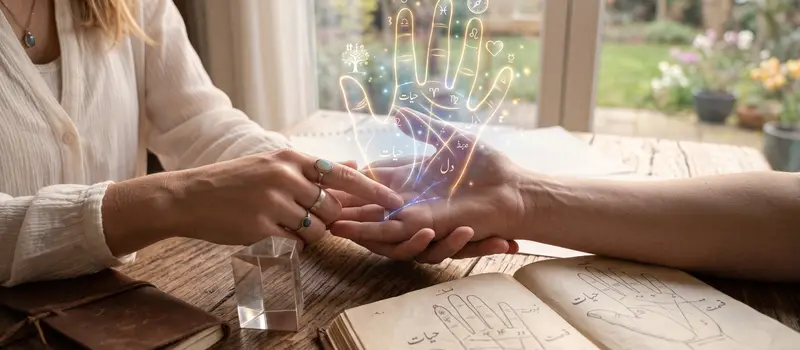
One person holding another's open palm across a table, with an old book of hand diagrams lying open beside them.
Illustration, not a reading. The glow drawn over the palm is an artist's overlay rather than any school's chart, and nobody in the picture is a practitioner or a client of this site.

What palmistry is

Palmistry — chiromancy, in older writing — reads the hand as a record: its proportions, the mounts of flesh at the base of the fingers, the set of the thumb, and the lines. Traditions that practise it exist across South Asia, the Middle East, China and Europe, and they do not agree with each other. What a line is called, where it is read from, and what a marking on it means all shift between schools.

That disagreement is the honest starting point. A page that presents one school's reading as the meaning of a line is hiding the existence of the others.

What a reader actually looks at

Far less of it is the lines than people expect. A practitioner typically begins with the shape of the hand and the proportion of palm to fingers, then the flexibility of the thumb, the mounts, the skin and only then the lines — and reads the lines against everything already noted rather than on their own.

The two hands

Most traditions read both. The common framing is that the non-dominant hand carries what was inherited or given, and the dominant hand what has been made of it — so the interesting reading is in the difference between them rather than in either alone. Some schools assign the hands by sex rather than by dominance, which is a different system and gives different answers from the same pair of hands.

The major lines

Five, in most schools. Four in some — the Sun line is where they differ.

Each card carries the same diagram with its own line picked out. The hand is drawn, not photographed — no real hand is the reference shape, and the lines on yours will not sit exactly where these do.

01 · Major line

Life line

Curves around the base of the thumb, from between thumb and index finger down towards the wrist.

Traditionally read as vitality, constitution and the shape of a life — not its length. A wide curve is usually taken to mean energy and warmth; a line hugging the thumb, a more guarded or home-centred life.

Breaks, chains and islands are read as periods of change or strain, and a doubled line beside it as support.

Where traditions differ. Where traditions part: many read a break as a decisive change of direction, others as an interruption that the second stretch recovers from.

Not this. A short life line does not mean a short life. There is no evidence of any kind linking the length of this line to lifespan, and any reader who tells you otherwise is either mistaken or frightening you on purpose.

03 · Major line

Heart line

The uppermost of the long lines, running across the palm under the fingers.

Traditionally read as how feeling is expressed rather than how much is felt. A line ending under the index finger is associated with idealism; under the middle finger, with a more self-directed attachment.

A curved line is associated with expressing feeling openly, a straight one with holding it inward. Branches upward are read as warmth, downward as disappointments weathered.

Where traditions differ. Some traditions read this line from the little finger inwards and some from the index outwards, which reverses what the start and end mean.

04 · Major line

Fate line

Rises up the centre of the palm towards the middle finger. Plenty of hands do not have one.

Traditionally read as direction and the degree to which a life feels steered — by circumstance, family, or one's own choosing.

A line starting at the wrist is associated with an early-set path; one starting higher, with a direction found later. Breaks and restarts are read as changes of course rather than failures.

Where traditions differ. Its absence is the most misread thing in palmistry. In most traditions it means a life less bound to one track, not a life without direction.

05 · Major line

Sun line

Runs towards the ring finger, often short, often absent. Also called the Apollo line.

Traditionally associated with recognition, creative satisfaction and ease with other people — the pleasure taken in work rather than the work itself.

Read as strongest when clear and unbroken. Several fine parallel lines are traditionally read as many interests rather than one.

Where traditions differ. Treated as a major line in some schools and a minor one in others, which is why lists of 'the major lines' vary between four and five.

Questions

Is palmistry scientifically proven?

No. Palmistry is a traditional divinatory practice with a long documented history, and there is no scientific evidence that the lines of a hand predict events, character or health. It is offered here as cultural and reflective material, not as fact.

Does the life line show how long I will live?

No. This is the most common and the most harmful misreading. Nothing about the length of that line corresponds to lifespan, and no responsible practitioner reads it that way.

Which hand should be read?

Most traditions read both and compare them. The non-dominant hand is commonly taken as inherited disposition and the dominant hand as what has been made of it — a framing, not a measurement.

Can a palm reading diagnose illness?

No, and it should never be used that way. Nothing on this page reads health, and any concern about your health belongs with a doctor.

Still being written. The mounts, the hand shapes, the fingers and thumb, the minor lines and the palm markings each need the same treatment as the five above — named, attributed to the tradition that reads them that way, with the disagreements left in. They are not here yet rather than here thinly.

Palmistry Disclaimer

Palmistry readings provided through this website are intended for informational, personal-interest and entertainment purposes only. Interpretations are based on traditional palmistry practices and the information voluntarily provided by the user.

They should not be considered professional medical, legal, financial, psychological or other professional advice, nor should they be treated as guaranteed predictions of future events.

By continuing, you acknowledge that you are requesting this information voluntarily and agree to use your own judgment when interpreting or acting upon it.